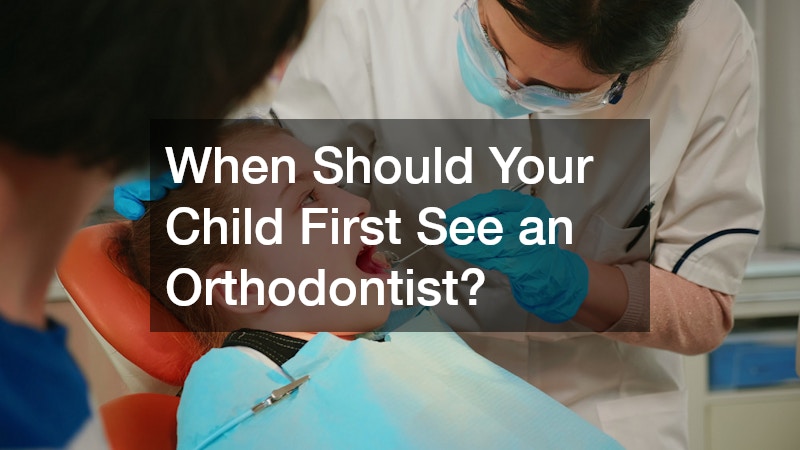
Watching your child grow involves a continuous series of memorable milestones, from their very first steps to losing their primary teeth. Among these crucial health checkups, dental care plays a vital role in their overall well-being. However, many parents find themselves uncertain about when to transition from standard pediatric dental visits to specialized oral alignment evaluations. Knowing the right time to schedule an initial consultation can set your child up for a lifetime of healthy, confident smiles while preventing complex structural issues down the road. Addressing potential jaw growth or tooth spacing concerns early often yields much smoother outcomes.
The Recommended Age for a First Evaluation
The American Association of Orthodontists recommends that children receive their initial screening by age seven. While this might sound surprisingly early, especially considering that most children still have a mix of baby teeth and adult teeth at this stage, it serves a specific preventive purpose. By seven years of age, the first permanent molars typically emerge, establishing the foundational back bite and allowing a specialist to evaluate side-to-side and front-to-back tooth relationships.
An early visit does not automatically mean your child will walk out wearing braces right away. In fact, immediate intervention is rarely necessary at this age. Instead, this initial checkup provides an essential baseline assessment, allowing the provider to monitor jaw growth and tooth eruption patterns over time. In clinic settings, a patient who arrives as unassigned to a specific long-term treatment plan simply enters a routine monitoring phase until the timing is ideal.
Early Warning Signs Parents Should Watch For
While age seven serves as a general guideline, certain developmental indicators might mean your child needs to see a specialist sooner. Parents can often spot subtle physical or behavioral cues at home that signal potential alignment or bite problems.
Visual and Structural Indicators
Visual signs often provide the clearest clue that a child’s mouth needs professional evaluation. Crowded or misaligned teeth that overlap, grow in sideways, or struggle to find space to erupt cleanly are common signals. Parents should also look out for protruding front teeth, where upper teeth stick out significantly over the lower lip, making them particularly vulnerable to accidental chipping or trauma. Additionally, irregular bite patterns—such as an underbite where lower teeth overlap top teeth, a crossbite where upper teeth sit inside lower teeth, or an open bite where front teeth fail to meet—warrant early professional attention.
Functional Cues and Daily Habits
Beyond physical appearance, functional difficulties and habitual behaviors can deeply influence jaw development. Children who experience frequent cheek biting or show clear discomfort when chewing solid foods may be coping with misaligned biting surfaces. Prolonged thumb sucking or pacifier use past age four or five can also reshape the palate and pull teeth out of alignment. Furthermore, persistent mouth breathing rather than nasal breathing can subtly alter facial structure and arch width over time. Finally, losing primary teeth unusually early—such as before age five—or retaining them far past typical developmental timelines can disrupt the proper path for adult teeth.
Understanding Interventional Treatment Options
When early issues are detected, specialists frequently utilize a two-phase treatment approach to guide natural growth rather than forcing drastic corrections later in adolescence.
Early Structural Guidance
The first phase of care focuses on structural guidance while a child’s jaw is still malleable and actively growing. The goal during this early stage isn’t necessarily to straighten every single adult tooth, but rather to prepare the mouth so adult teeth have proper space to emerge naturally. For instance, palatal expanders can gently widen a narrow upper jaw to eliminate crossbites and create necessary arch space. In other instances, space maintainers hold crucial gaps open if primary teeth fall out too early. Partial braces might also be applied to protect severely protruding front teeth from physical injury or to correct traumatic bite interferences before they damage surrounding tissue.
The Monitoring Window and Final Alignment
After the first phase accomplishes its specific goals, a resting and monitoring period follows. During this time, remaining permanent teeth drop into place naturally. The child visits the office for periodic checkups every six to twelve months so the specialist can observe ongoing development. Once all adult teeth have fully erupted—typically between ages eleven and thirteen—the second phase begins. This final phase involves full braces or clear aligners to align each individual tooth into its optimal position for long-term health, proper function, and aesthetic balance.
Long-Term Advantages of Early Consultations
Addressing jaw alignment and tooth spacing during childhood offers distinct biological and practical advantages compared to waiting until adulthood. Early assessment takes full advantage of natural growth spurts, making it much easier to reshape bone structure without invasive procedures. Furthermore, correcting severe aesthetic or functional issues early helps children avoid feeling self-conscious during crucial developmental years. Deferred treatment, by contrast, often deals with dense, fully matured bone that may require tooth extractions or surgical expansion to achieve similar results. By acting early, families can simplify future treatment complexity and reduce overall time spent wearing corrective appliances.
Taking the Next Steps for Your Child
If your child is approaching their seventh birthday or is displaying any concerning bite patterns, booking an evaluation provides clarity and peace of mind. You do not need a formal referral from a general dentist to schedule an appointment with an orthodontist, although family dentists frequently highlight potential concerns during routine cleanings. If no immediate treatment is necessary after the exam, your child simply enters an observational program. This ongoing oversight guarantees that if corrective action ever becomes necessary, it will begin at the exact moment necessary to produce the most comfortable, efficient, and lasting outcome for your child’s smile.